
 Call us: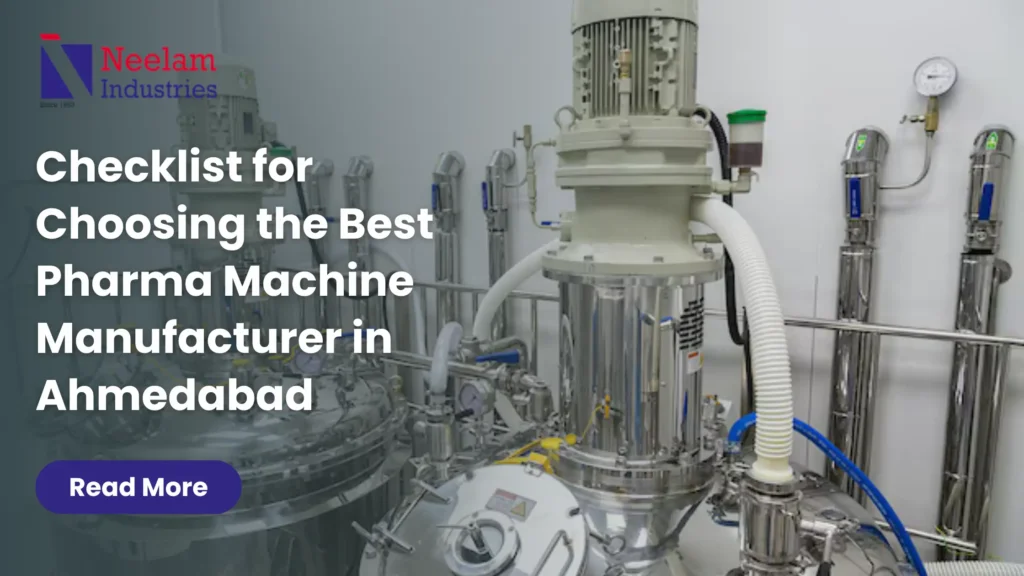
Choosing the right pharma machine manufacturer in Ahmedabad is one of the most important decisions for any pharmaceutical company. Whether you are setting up a new plant or upgrading existing production lines, your machinery directly impacts product quality, regulatory compliance, production efficiency, and long-term profitability.
Ahmedabad and Gujarat have become one of India’s strongest hubs for pharmaceutical manufacturing equipment. With hundreds of suppliers available, selecting the right partner can feel overwhelming. This checklist will help you make a confident, informed, and future-ready decision.
1. Check GMP Compliance and Manufacturing Standards
The first and most important factor is whether the manufacturer follows GMP (Good Manufacturing Practices). Pharma equipment must meet strict international standards to ensure safety and consistency.
A reliable manufacturer should provide:
- GMP-compliant design and fabrication
- Documentation support for validation (IQ, OQ, PQ)
- Material traceability reports
- Clean welding and finishing standards
- Compliance with WHO and USFDA guidelines
If a manufacturer cannot provide proper documentation, it is a major red flag.
2. Evaluate Industry Experience and Expertise
Experience plays a huge role in pharmaceutical machinery manufacturing. A company with decades of experience understands real production challenges, regulatory expectations, and process requirements.
Check:
- Years of industry experience
- Types of pharma projects completed
- Experience in injectable, biotech, or sterile manufacturing plants
- Installation base across India and exports
Manufacturers with strong experience are more likely to deliver reliable and long-lasting machines.
3. Assess Product Range and Specialisation
A good pharma machine manufacturer should offer a wide range of equipment for different production needs. This indicates technical capability and manufacturing depth.
Common equipment includes:
- Sterilization systems
- CIP and SIP systems
- Water for Injection (WFI) systems
- Filling and sealing machines
- Mixing and processing vessels
- Distillation systems
- Sterile manufacturing equipment
A strong product portfolio ensures you can get complete solutions from a single source instead of multiple vendors.
4. Check Customisation Capability
Every pharmaceutical plant has unique requirements depending on product type, batch size, and regulatory market.
A reliable manufacturer should offer:
- Custom-designed machinery
- Layout-based equipment planning
- Scalable systems for future expansion
- Process-specific engineering support
Customisation is especially important for injectable, biotech, and vaccine manufacturing plants.
5. Quality of Materials and Construction
Material quality directly affects machine durability and contamination control. In pharmaceutical manufacturing, stainless steel quality is extremely critical.
Look for:
- SS 316L or higher-grade stainless steel
- Electropolished internal surfaces
- Hygienic design with no dead zones
- Corrosion-resistant components
- High-quality sealing and joints
Poor material quality can lead to contamination risks and frequent maintenance issues.
6. Automation and Technology Integration
Modern pharmaceutical plants are moving towards automation and digital control systems. Choosing a manufacturer that integrates advanced technology is a long-term advantage.
Key features to look for:
- PLC-based control systems
- SCADA integration
- Real-time monitoring
- Data logging and reporting
- Remote troubleshooting support
Automation improves consistency, reduces human error, and helps in regulatory audits.
7. After-Sales Support and Service Network
After-sales service is just as important as machine quality. Pharma production cannot afford long downtime.
Check:
- Availability of technical support team
- Response time for breakdowns
- Spare parts availability
- Annual maintenance contracts (AMC)
- Remote support capability
A strong service network ensures uninterrupted production and long-term reliability.
8. Validation and Documentation Support
Pharmaceutical equipment must be validated before production use. A good manufacturer should provide complete documentation support.
This includes:
- Installation Qualification (IQ)
- Operational Qualification (OQ)
- Performance Qualification (PQ)
- Material certificates
- Calibration reports
Without proper validation support, regulatory approval becomes difficult.
9. Client Portfolio and Market Reputation
Always check who the manufacturer has worked with. Established companies usually supply to:
- Pharma formulation plants
- Biotech companies
- Export-oriented manufacturing units
- Government-approved facilities
You can also ask for site visits or references to verify machine performance in real environments.
10. Scalability and Future Expansion Capability
Your pharma plant will grow over time. Equipment should support expansion without requiring complete replacement.
Check whether the manufacturer offers:
- Modular system designs
- Capacity upgrade options
- Integration with future automation systems
- Turnkey project support
This ensures long-term cost savings and operational flexibility.
11. Energy Efficiency and Operational Cost
Modern pharma machinery should not only perform well but also reduce operational costs.
Look for:
- Energy-efficient motors and systems
- Optimised steam and water usage
- Low maintenance design
- Reduced downtime systems
Efficient machinery improves ROI over time.
12. Regulatory Compliance and Export Readiness
If you plan to export, your equipment must meet global regulatory standards.
Ensure the manufacturer understands:
- USFDA requirements
- EU GMP guidelines
- WHO standards
- Schedule M compliance in India
Export-ready machinery opens global market opportunities.
13. Engineering Strength and In-House Manufacturing
Manufacturers with in-house design and fabrication units are more reliable than those who outsource everything.
Benefits include:
- Better quality control
- Faster delivery timelines
- Custom engineering flexibility
- Improved cost efficiency
Strong engineering capability ensures better long-term machine performance.
14. Industry-Specific Equipment Capability
Different pharma segments require different machinery standards.
For example:
- Injectable plants require sterile systems
- Biotech plants require precise fermentation systems
- API units require robust processing equipment
In many biotech applications, equipment like a stainless steel fermentation tank plays a critical role in ensuring controlled microbial growth and consistent output quality.
Conclusion
Selecting the best pharma machine manufacturer in Ahmedabad is not just about comparing prices. It is about choosing a long-term partner who understands compliance, engineering precision, and pharmaceutical production challenges.
By following this checklist, you can ensure:
- Better product quality
- Regulatory compliance
- Higher production efficiency
- Lower maintenance costs
- Strong ROI in the long run
A reliable manufacturer becomes the foundation of your pharmaceutical success. Choose wisely, evaluate thoroughly, and invest in technology that supports your future growth in the competitive pharma industry.