
 Call us:
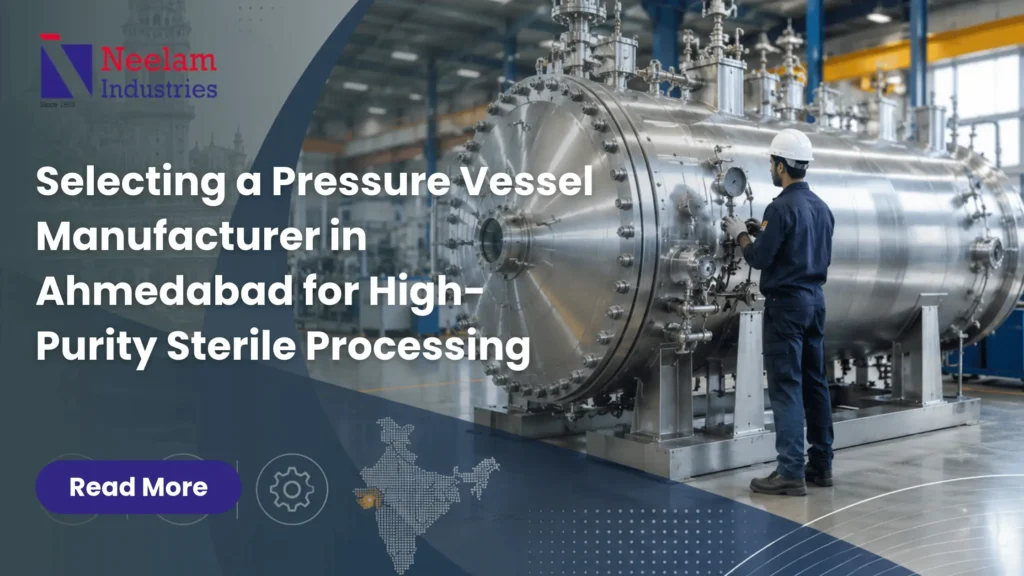
High-purity sterile processes will require equipment that will help in maintaining the quality of products, preventing contamination, and operating safely in controlled environments. Pressure vessels have an integral part in pharmaceutical industries, the biotech industry, health care, and other industries that require sterile processing.
But, when selecting a pressure vessel manufacturer in Ahmedabad, one needs to take into account many more factors than just comparing prices or equipment dimensions. Suppliers should understand the pressure, quality of materials, hygiene, fabrication, and regulations in their industry.
This guide will provide you with the information that will be helpful when choosing pressure vessels for pharmaceutical companies in India.
Why Does Pressure Vessel Selection Matter in Sterile Processing?
A pressure vessel is a closed container that holds liquids or gases at a pressure different from the air outside. In a pharma plant, it may handle mixing, heating, storage or sterilisation.
In high-purity work, small design flaws cause big problems. A rough surface, the wrong material or a corner you cannot clean can all put your product at risk.
A well-built vessel helps you:
- Keep hygienic conditions
- Lower contamination risk
- Handle pressure safely
- Simplify cleaning
- Maintain steady quality
Take a plant making sterile liquid formulations. It needs smooth internal surfaces, sanitary connections, and a shape that works with its own cleaning and steam routine.
7 Factors to Consider When Selecting a Manufacturer
1. Check Experience in Pharmaceutical Equipment
A general fabricator and a pharmaceutical equipment maker are not the same thing. Industrial tanks and sterile vessels follow different rules.
Ask about:
- Past pharma projects
- Sterile processing work
- Vessel types built
- Installation support
A team that has done this before already knows why cleanability matters.
2. Evaluate Material Quality and Grade
The type of material determines the life of the vessel and how resistant it is to corrosion.
There are two types of stainless steel commonly used:
- SS 304: General purpose and low corrosion
- SS 316L: Preferred for pharmaceutical applications
You have to use the appropriate stainless steel based on your product, cleaning agent, and temperatures. Always ask for material test certificates (MTCs). This should not be taken verbally.
3. Understand the Design and Fabrication Standards
Every vessel is designed to keep certain conditions in mind. These include:
- Maximum permissible pressure
- Design temperature
- Thickness of the wall
- Corrosion allowance
- Pressure relief equipment
Find out which design code they use, such as ASME section VIII or the Indian Standard. Also ask for the drawing calculations.
4. Inspect Internal Surface Finish and Hygienic Design
Surface quality matters a lot here. Rough welds and hidden corners make cleaning hard and let residue build up.
Look for:
- Smooth internal surfaces
- Well-finished welds
- Fully draining bottoms
- Hygienic connections
- Easy inspection access
If you use CIP or SIP, the design must suit your real cleaning cycle. Also remember that a shiny surface does not equal sterility. Validation and process controls still do the heavy lifting.
5. Review Testing and Quality Documentation
Quality should start on the fabrication floor, not at your gate. A reliable maker keeps records throughout.
Request these:
- Material certificates
- Approved drawings
- Welding procedure specifications
- Welder qualification records
- NDT reports
- Pressure test reports
- Final inspection certificate
Your quality team will need all of them during audits.
6. Check Customisation and Integration Capabilities
No two plants run the same way. A standard vessel may not fit your layout or your process.
Discuss options like:
- Capacity and size
- Jacketed construction
- Agitators
- Sensors
- Sampling points
- Piping connections
Also think about how the vessel will link with existing utilities and automation. One plant may need a jacketed vessel for controlled heating and cooling. Another may need insulation and special mixing.
7. Compare After-Sales Service and Maintenance Support
Performance does not end at delivery. Regular inspection and quick help keep a vessel reliable.
Ask about:
- Commissioning help
- Spare parts supply
- Technical support
- Response time
A slightly higher price can be better value when the supplier actually picks up the phone.
Understanding Indian Pharmaceutical Regulations
Compliance is part of equipment choice, not an afterthought. Indian manufacturers must follow the Drugs and Cosmetics Rules, 1945, including the revised Schedule M.
Revised Schedule M focuses on GMP, quality systems, risk management and suitable plant and equipment. That makes documentation and equipment suitability very important.
Other rules may apply too. For example, the Static and Mobile Pressure Vessels (Unfired) Rules, 2016 cover certain gas storage and transport vessels. Not every process vessel falls under them.
Before ordering, check with your engineering, QA and regulatory teams.
Common Mistakes to Avoid When Choosing a Supplier
Even experienced buyers slip up here. Watch out for these:
- Price-only decisions: hidden gaps in testing
- Ignoring compatibility: corrosion trouble later
- Overlooking cleaning: poor vessel geometry
- Incomplete documents: audit headaches
- No future planning: capacity too small
- Weak support: longer downtime
A detailed technical talk before the order prevents most of these.
Practical Checklist Before Finalising Your Purchase
Use this when comparing suppliers in Ahmedabad or elsewhere in India.
| Area | What to verify |
| Experience | Pharma and sterile projects |
| Material | Correct grade and MTCs |
| Design | Pressure, temperature, capacity calculations |
| Surface finish | Hygienic finish, clean welds |
| Safety | Relief devices, protection systems |
| Testing | Pressure tests, relevant NDT |
| Documentation | Drawings, certificates, records |
| Support | Installation, commissioning, maintenance |
Do not close the deal until specifications, testing, delivery terms and paperwork are agreed in writing.
Frequently Asked Questions
1. How to select a pressure vessel maker in Ahmedabad?
Compare their experience in the pharma industry, quality of materials, manufacturing process, hygiene tests, and customizations offered before making a decision.
2. Which stainless steel grade should be used for pharmaceutical pressure vessels?
The commonly used one is SS 316L due to its resistance to corrosion and suitability for hygienic fabrication. SS 304 can suit lighter applications. Your process fluid and cleaning chemicals should drive the final choice.
3. Why is the internal surface finish important in sterile processing?
An appropriate finish will provide fewer areas where residues and contaminants can accumulate. The process of cleaning and inspections will be easier with an appropriate finish. Specify the appropriate finish according to your product and cleaning process.
4. What kind of documents shall I ask for before buying?
Material certificates, drawings, welding sheets, non-destructive testing certificates, pressure testing certificates, and final inspection certificates should be asked for. Based on the purpose, more documents can be asked for.
5. Can pressure vessels be customised for pharmaceutical manufacturing?
Yes. Makers can adjust capacity, jackets, insulation, mixers, sensors, valves, and sanitary connections. Base the design on your process, layout, and cleaning needs.
Conclusion
The right pressure vessel comes down to safety, material quality, hygienic design, and sound fabrication. For pharma, it also has to support easy cleaning and steady product quality.
When you shortlist a pressure vessel manufacturer in Ahmedabad, look past the price tag. Focus on technical skill, build quality, test records, and long-term service.
Planning an upgrade or a new line? Visit Sterilepharmamachine.com to explore the equipment range and talk through your processing needs with the team.