
 Call us:
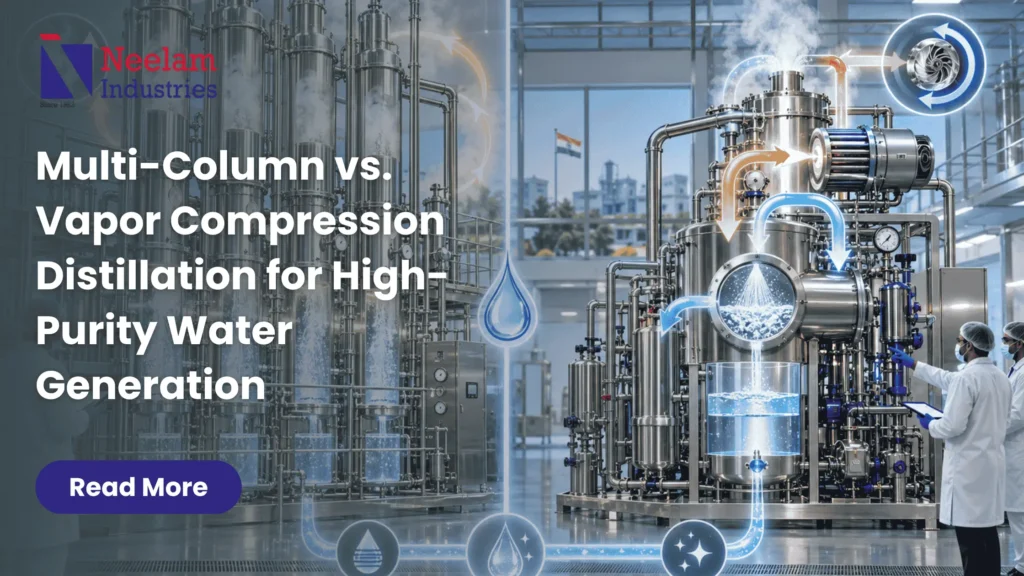
The production of pharmaceuticals needs pure water, particularly when the purity of water might affect the safety of the drugs produced. Consequently, selecting an appropriate distillation system is crucial for any pharmaceutical factory.
Two common types of technology used are multi-column distillation and vapor compression distillation. Both technologies are capable of producing quality distilled water; however, their working processes and requirements are different.
To an IV fluids plant manufacturer in India, such knowledge is quite helpful in developing a water-generating system to be used in pharmaceutical production.
What Is High-Purity Water Generation?
High-purity water is water cleaned of salts, microbes, organic matter and pyrogens. In pharma, the strictest grade is Water for Injection (WFI), which goes into products that enter a patient’s bloodstream.
No single machine does the whole job. A typical system chains together:
- Pre-treatment and filtration
- Reverse osmosis
- Softening or demineralisation
- Final distillation
- Storage and distribution loop
Think of distillation as the last checkpoint. The earlier steps simply make its work easier.
Multi-Column Distillation: How Does It Work?
A multi-column still links several columns in a row. Plant steam heats the first column and makes pure steam. That steam heats the second column, and the pattern repeats down the line.
Because each stage reuses heat from the one before, you get far more water per unit of energy than an old single-stage still can give.
Key Benefits of Multi-Column Distillation
Large plants like this design for its steady, predictable output.
- High output
- Continuous running
- Strong pyrogen removal
- Smart steam reuse
- Fewer moving parts
It works best when a reliable boiler is already on site. If your steam supply is shaky, this still will feel it.
Vapor Compression Distillation: What Makes It Different?
Vapor compression reuses its own steam. Vapour from the boiling chamber goes into a compressor, which raises its pressure and temperature. That hotter vapour then heats the next batch of incoming water.
It works a bit like a heat pump. After start-up, the still leans on electricity instead of large volumes of fresh steam.
Advantages of Vapor Compression Distillation
- Low steam need
- Little cooling water
- Compact footprint
- Strong heat recovery
- Continuous production
The catch is the compressor. It’s a moving part, it needs regular servicing, and it draws real power. Whether you save money depends on your local steam and electricity rates.
Multi-Column vs. Vapor Compression: Key Differences
Here’s a quick side-by-side before we get into the details.
| Factor | Multi-Column | Vapor Compression |
| Main energy source | Plant steam | Electricity |
| Steam use | Moderate to high | Low |
| Power need | Lower | Higher |
| Cooling water | Higher | Very low |
| Best fit | Large capacities | Small to medium |
| Maintenance focus | Columns, valves | Compressor, controls |
Real performance shifts with design, feed water quality and utility costs. Treat the table as a starting point, not a verdict.
Which System Should an Indian Pharmaceutical Plant Choose?
There’s no universal answer. A plant near Ahmedabad faces different utility realities than one in Hyderabad or Pune. Work through these five questions.
1. Required Water Capacity
- Daily WFI demand
- Peak hourly demand
- Expansion plans
Big, continuous demand usually points towards multi-column.
2. Steam Availability
- Boiler capacity
- Spare steam load
- Validated distribution
If your boiler already has room to spare, multi-column fits in naturally. If it’s stretched, VCD can spare you an expensive upgrade.
3. Electricity Costs
- Local tariff
- Compressor load
- Power backup
Over ten years, a small difference in running cost can add up to several lakhs of rupees. Ask suppliers for consumption per 1,000 litres of WFI, in writing.
4. Available Space
- Equipment footprint
- Maintenance access
- Tanks and piping
Multi-column needs more floor area and height. VCD is easier to squeeze into tight layouts.
5. Regulatory and Validation Requirements
- Schedule M compliance
- IP, USP, WHO norms
- EU GMP for exports
- IQ, OQ, and PQ documents
Good documentation should arrive with the equipment, not months after installation.
Common Mistakes to Avoid
Most plants repeat the same few errors:
- Comparing steam only: electricity costs matter just as much.
- Ignoring expansion: today’s demand won’t stay today’s demand.
- Skipping service checks: a breakdown mid-batch is costly.
- Missing utility checks: confirm steam, power and water first.
- Late validation planning: start documents on day one.
- Forgetting the loop: hot storage and dead-leg-free piping prevent many audit failures.
A total cost of ownership calculation beats comparing quotations every time.
Practical Takeaways for Pharmaceutical Manufacturers
Before you finalise anything, prepare a basic assessment sheet:
- WFI production rate
- Feed water report
- Steam and power available
- Space and layout
- Cleaning and maintenance needs
- Validation expectations
- Five-year growth plan
If possible, visit a running installation. Watching a still work every day teaches you more than any brochure will.
FAQs
1. Which is more energy efficient: multi-column or vapor compression distillation?
Vapor compression requires much less steam, but it requires electric power to run the compressor. Base the assessment on the actual cost of your steam and power.
2. Can multi-column distillation be applied to WFI preparation?
Yes, multi-column distillation is well established for use in WFI preparation where design, operation, monitoring, and validation are appropriate.
3. Does vapor compression need steam at all?
Mostly for start-up, and only in small amounts during normal running. The exact need depends on the design and operating conditions.
4. How should a pharma company choose between the two?
Compare capacity, utilities, running costs, space, maintenance and validation support. Then factor in your growth plans.
5. What should an IV fluid unit look for in distillation equipment?
Reliable water quality, the right capacity, sanitary design and utility compatibility. Also check monitoring features, validation support and service availability.
Conclusion
These two systems both have their place in water production for pharmaceutical purposes. While multi-column technology is best for facilities having abundant steam and high water demand, vapor compression technology is better suited for compact plants lacking steam or cooling water.
Finding the proper system depends on being truthful with figures rather than seeking the lowest quotation. Cooperation with an iv fluid plant manufacturer can help you find the proper equipment for your needs.
If you have any questions regarding sizing, utilities, or validation of your installation, contact us at Neelam Industries.