
 Call us: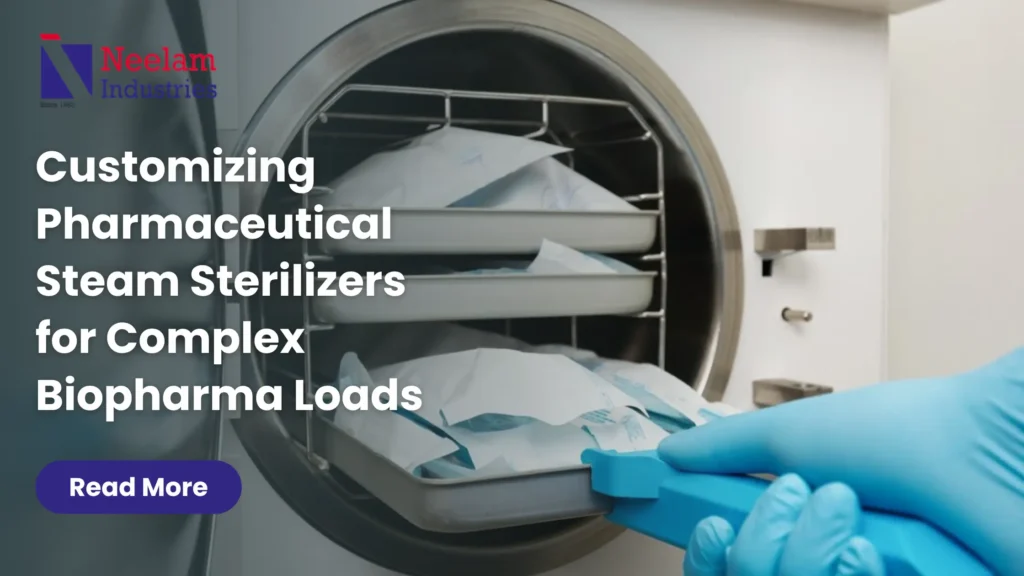
Sterilization requirements can be highly varied in pharma and biopharma products. They might include loads of glass bottles, stainless steel items, rubber materials, filters, tubing or porous material. Running every load on the same sterilization cycle will impact the performance of the process and safety of the product.
This is the reason that a customised approach becomes critical when choosing the right steam sterilizer. An experienced autoclave manufacturer in Ahmedabad will be able to tailor the equipment and cycle according to your specific needs regarding the real load characteristics, layout of your facility, and validation procedure.
The point was never just to hit a target temperature. The sterilizer has to deliver repeatable heat and steam penetration across the entire load, every time, while protecting whatever’s sensitive inside it.
Why Complex Biopharma Loads Need Customisation
Steam moves easily through a simple, uniform load. Complex biopharma loads don’t cooperate the same way.
Tightly packed tubing, wrapped components, porous materials, and vessels with narrow openings all make air removal and steam penetration harder. Add in materials that heat at different rates, and a standard cycle starts looking less like a solution and more like a risk.
A customised sterilizer takes all of this into account:
- Load size and configuration
- Material type and sensitivity
- Porosity and packaging
- Air removal needs
- Steam quality
- Chamber dimensions
- Condensate drainage
- Cooling requirements
- Cycle monitoring
This is really about not forcing your production load into a cycle that was designed for something else entirely.
What an Autoclave Manufacturer in Ahmedabad Should Consider
Choosing the right equipment starts with understanding your process — chamber capacity is just one line item, not the whole decision.
A serious Autoclave manufacturer in Ahmedabad working with pharma and biotech facilities looks at the full sterilisation workflow before recommending anything.
1. Load Configuration
The same chamber often handles different products across different production runs. A cycle built for empty glassware won’t necessarily work for a dense load of packaged components.
Load patterns need to be defined before cycle development even starts. Where containers, trays, and tubing sit inside the chamber genuinely affects steam circulation and temperature distribution.
2. Steam and Air Removal
Steam sterilisation works because saturated steam makes solid contact with every surface. If air stays trapped anywhere in the chamber or load, that contact breaks down and heat transfer turns uneven.
Vacuum-assisted air removal, well-designed piping, and appropriate chamber geometry all help here. Steam quality matters just as much — non-condensable gases and excess moisture can quietly undermine an otherwise good cycle.
3. Chamber Design
Chamber size should match what your facility actually runs, not what looks impressive on paper.
A lab or small-batch operation may need a compact unit, while a full manufacturing facility needs higher capacity altogether. Door configuration, chamber orientation, loading arrangement, and available floor space all shape the final design.
For cleanroom setups, pass-through configurations help keep clean and less-clean areas properly separated while material still moves through in a controlled way.
Custom Cycle Development
The real value of a customised steam sterilizer is being able to build cycles around your specific loads, rather than adapting your loads to fit someone else’s cycle.
A typical cycle runs through:
- Air removal — clears air from chamber and load
- Steam admission — raises temperature with steam
- Exposure — holds defined sterilisation conditions
- Exhaust — releases steam post-exposure
- Drying or cooling — brings load to handling condition
These parameters should come out of proper process development and validation, never copied over from a different application, because it seemed close enough.
A load of long tubing lengths, for instance, behaves nothing like a tray of stainless-steel components. Recognising that difference early is what makes the process reliable and repeatable later.
Validation and Monitoring Matter
Customisation doesn’t stop once the equipment is designed. You still have to prove the process works, consistently, batch after batch.
Most pharmaceutical manufacturers build in temperature mapping, heat penetration studies, and biological or chemical indicators as part of their validation strategy, depending on what the application calls for.
Data recording matters just as much. Sensors, PLC-based controls, alarms, cycle reports, and electronic records all support ongoing process monitoring and increasingly, Indian auditors expect to see this as standard, not as an add-on.
Equipment and validation practices should stay aligned with applicable GMP expectations and your own quality system throughout.
Practical Benefits of a Customised Sterilizer
A properly engineered system pays off in several ways:
- Better steam penetration into difficult loads
- More consistent sterilisation results
- Lower risk of under-processing
- Improved repeatability between batches
- Better protection for heat-sensitive parts
- Easier documentation
- Smoother cleanroom compatibility
Take a biopharma facility sterilising assembled process components as an example. A standard cycle might simply fail to address trapped air or density differences across the load. A customised cycle, built around the actual configuration and verified through proper studies, closes that gap.
Common Mistakes to Avoid
Choosing Capacity Without Studying the Load
A bigger chamber isn’t automatically the better choice. Poor loading planning creates dead spaces that quietly disrupt steam circulation.
Using One Cycle for Every Product
Different materials and configurations often need different sterilisation approaches. Cycle selection should follow the validated process, not convenience.
Ignoring Steam Quality
Even a well-built chamber underperforms if the steam supply itself is off. Generation, distribution, and condensate management all deserve a proper look.
Treating Validation as an Afterthought
Validation belongs in the design conversation from day one. Retrofitting it later almost always costs more time and money.
Overlooking Facility Integration
Door orientation, utilities, drainage, cleanroom interfaces, and operator access all of it needs sorting before installation day, not during it.
FAQs
1. Why choose an Autoclave manufacturer in Ahmedabad for a biopharma facility?
There is a very strong base of both Pharmaceutical and Engineering companies in Ahmedabad. Coordination becomes easier when dealing with a good manufacturer who is located close by.
2. Can a steam sterilizer handle with various biopharma loads?
Yes, a proper one can be set up to work with various loads, although each load will require its own cycle design and validation.
3. Which materials can be sterilized through steam sterilization process?
Some common ones are stainless steel, glass, and some heat-stable rubber or plastic components. It is important to consider material compatibility prior to choosing a cycle.
4. Is custom cycle development necessary for every pharmaceutical load?
Not necessarily, but if there is a change in your loading pattern, materials or density, then you may want to look at the current cycle again.
5. What should I check before selecting an Autoclave manufacturer in Ahmedabad?
Consider their pharmaceutical experience, engineering skills, chamber design, levels of automation and documentation, validation services offered, and their understanding of your load.
Conclusion
Complex biopharma loads need more than a standard steam sterilisation cycle running on autopilot. Load configuration, steam penetration, chamber design, air removal, monitoring, and validation all shape the final result together.
Working with an experienced Autoclave manufacturer in Ahmedabad helps pharmaceutical and biotech companies build a sterilizer that fits their actual production reality, instead of squeezing their process into someone else’s standard design.
For customised pharmaceutical steam sterilizer requirements, Sterile Pharma Machine can help you evaluate your load, your process, and the right equipment configuration.