
 Call us:
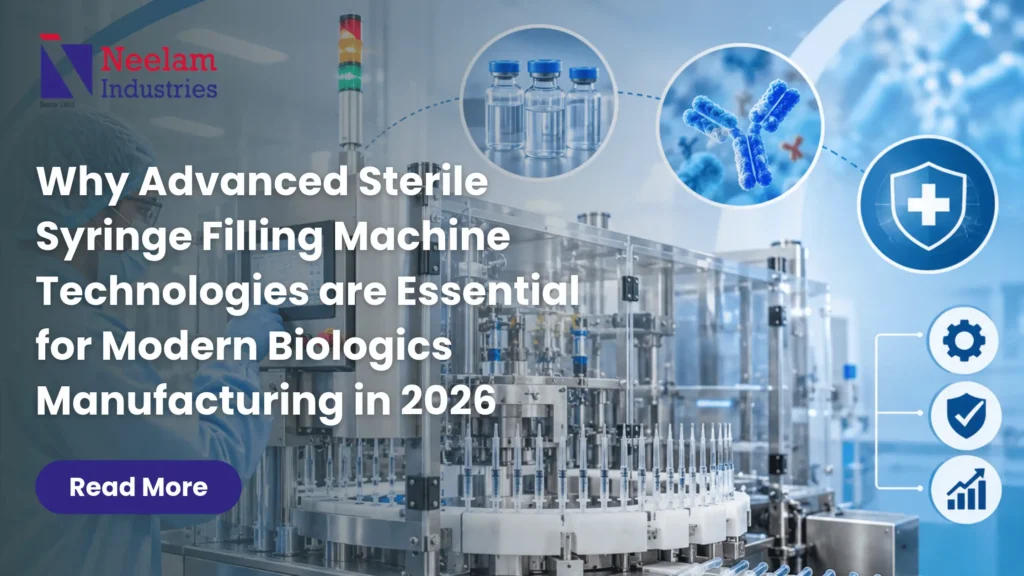
Biologics are becoming a big part of India’s pharma story. Vaccines, insulin and monoclonal antibodies come from living systems, so even a small change in temperature or pressure can affect the final product.
That’s why pre-filled syringes are catching on. Doses are accurate and handling is minimal. But making them needs serious equipment, and choosing among pre filled syringe filling and stoppering machine manufacturers is about more than speed. It’s about protecting a costly medicine and keeping every batch consistent.
Why Are Advanced Syringe Filling Technologies Important for Biologics?
Biologics aren’t like tablets. Germs, particles, heat or rough handling can easily spoil a batch. Modern machines help in these ways:
- Contamination prevention – Filling is done in enclosed filling to minimize contamination.
- Consistent volume – Every syringe receives the same quantity.
- Safe handling – The delicate proteins undergo gentle treatment.
- Closure – Precise stoppering prevents spillage during transportation of the drug.
- Process monitoring – Operators detect deviations in the process early.
For Indian injectable manufacturers, it implies lesser rejects.
5 Technologies Transforming Modern Syringe Filling Operations
1. Automated Filling and Stoppering Systems
This single line will be sufficient for loading, filling, stoppering, and unloading with almost no human interference. Check for:
- Adjustable parameters
- Repeatable performance
- Suitable contact materials
2. Isolator and RABS Technology
These put a physical wall between operators and the open product.
- Isolators: Fully enclosed, highest protection.
- RABS: Restricted operator access.
- Glove ports: Allow interventions without opening the zone.
The right pick depends on your product, facility and contamination control plan.
3. Precision Dosing and Filling
Biologics are expensive, so a few drops of error add up. An insulin maker, for example, needs the same volume in every syringe.
- Programmable volumes
- Controlled filling speed
- Easy-to-clean parts
Verify accuracy through qualification, not just the brochure.
4. Automated Stoppering and Closure Control
Poor stopper placement can hurt container closure integrity and stability. Also consider:
- Barrel dimensions
- Stopper compatibility
- Silicone levels
- Particle generation
5. Digital Monitoring and Process Automation
Machines can capture fill amount, throughput, alarms, and manufacturing tally. The information helps quality teams investigate deviations. If required, connect them to the MES for greater awareness. This helps in validation processes but does not replace them.
How Do These Machines Support Indian Biologics Manufacturers?
The hubs of Ahmedabad, Hyderabad, Pune, Mumbai and Bengaluru are increasing their injectable capacity, and hence equipment choice is an investment on which a lot depends.
| Manufacturing need | How advanced equipment helps |
| Sterility | Supports controlled aseptic operations |
| Consistency | Repeatable filling and stoppering |
| Less wastage | Accurate dosing |
| Documentation | Records key parameters |
| Efficiency | Fewer manual interventions |
| Audit readiness | Supports qualification and validation |
Results still depend on facility design, training and maintenance.
What Should You Check Before Selecting Syringe Filling Equipment?
Don’t stop at price and capacity. Make sure to consider the following five points:
- Compatibility of the product: Its viscosity, sensitivity, and composition.
- Compatibility of the syringe: Size of the barrel, stoppers, and materials used.
- Sterilized design: Compatibility with RABS or isolator and cleanroom standards.
- Help with validation: Documentation for DQ, IQ, OQ, and PQ.
Also check arrangements for SAT and FAT before completing the project.
Common Mistakes to Avoid During Equipment Selection
Purchasing the equipment quickly is never a good idea even if the machine itself is not bad.
- Choosing on speed alone: Output isn’t quality.
- Ignoring closure integrity: A good fill means little with a weak seal.
- Forgetting future products: Your next molecule may differ.
- Skipping validation planning: The machine must fit your quality system.
- Avoiding maintenance: risk of downtime and contamination follows.
A detailed technical review now saves expensive problems later.
Regulatory Considerations for Sterile Manufacturing in India
Your equipment must fit the rules you work under. India’s revised Schedule M under the Drugs Rules, 1945, sets GMP requirements. CDSCO also issued a circular on 7 August 2024 asking manufacturers to assess their compliance. WHO’s TRS 1044 Annex 2 adds guidance on aseptic processing.
Focus on:
- Aseptic processing
- Cleaning and sterilisation
- Environmental monitoring
- Process validation
- Batch traceability
A machine alone doesn’t make you compliant. The whole process, facility and quality system must meet the requirements.
What Should Buyers Expect from Pre Filled Syringe Filling and Stoppering Machine Manufacturers?
A reliable supplier explains clearly what the machine can and can’t do. Ask for:
- Technical specifications and layout
- Accuracy and repeatability data
- Material certificates
- Cleaning and sterilisation documents
- FAT and SAT protocols
- Commissioning and training support
- Spare parts availability
For the plants in Gujarat and other places, it is much better to choose supply companies with a local maintenance service.
Frequently Asked Questions
1. What is a syringe filling and stoppering machine?
It fills a measured dose of medicine into sterile syringe barrels and fits the stopper to close them. It’s common for vaccines and insulin.
2. Why are pre-filled syringes useful for biologics?
They’re ready to use, support accurate dosing and cut manual transfer. Suitability still depends on formulation stability.
3. How does an isolator improve sterile filling?
It creates a physical barrier around critical operations. That limits operator access and protects exposed components.
4. What should I check before buying automatic filling equipment?
Check filling accuracy, syringe compatibility, stoppering performance, contamination controls, validation papers and service support.
5. How do I evaluate equipment suppliers?
Review their technical experience, quality documentation, installation record, validation help and maintenance support.
Conclusion
The need for advanced filling and stoppering technologies has become very important for the safety and consistency of biologics. Precision dispensing, closure systems, isolators, and digital monitoring all provide you with greater control over sterile manufacturing.
For Indian companies, the appropriate machinery not only prepares you for higher quality standards but also for the future.
Looking to upgrade or set up a new line? Check out SterilePharmaMachine to learn more about your options.