
 Call us:
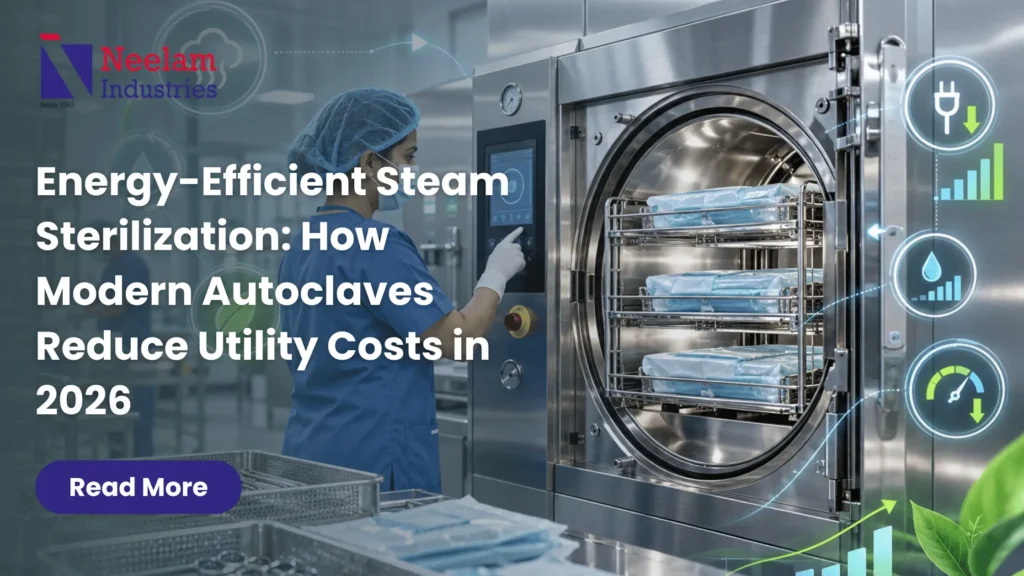
The cost of energy is becoming a growing concern among manufacturers, hospitals, laboratories, and other health care service providers in India. The steam sterilization process plays an important role in ensuring the hygiene and safety of products; however, it uses vast quantities of electricity, water, and fuel.
Sterilisation is non-negotiable in pharma units, hospitals and labs. But what it costs you each month depends on the machine you pick and how your team runs it.
If you are comparing autoclave steam sterilizer manufacturers in Ahmedabad, look beyond the price tag. A machine that wastes steam will quietly drain your budget for years. This guide discusses how modern autoclaves reduce utility costs in 2026.
Why Does Steam Sterilisation Consume So Much Energy?
Steam sterilisation kills microbes using saturated steam at controlled pressure and temperature. Making that steam takes energy. So does heating the chamber, holding the temperature, and then cooling and drying the load.
Small losses repeat with every cycle. Over a year, they become a big number.
Common culprits:
- Heat loss
- Water wastage
- Long cycles
- Half-empty loads
- Poor maintenance
Spotting these early tells you where the savings are hiding.
6 Ways Modern Autoclaves Reduce Utility Costs
1. Improved Chamber Insulation
Good insulation keeps heat inside the chamber instead of warming up your room. The machine needs less energy to hold its temperature, especially when it runs several cycles a day.
In hot cities like Ahmedabad or Surat, a cooler room also eases the air-conditioning load. Actual savings depend on design and usage.
2. Intelligent Temperature and Pressure Controls
Modern controllers track temperature, pressure and cycle progress in real time. They help stop operators from picking the wrong programme and avoid needless heating.
Still, efficiency must never cut into sterility. Every cycle should be validated for its load.
- Real-time monitoring
- Programme lock
- Fewer errors
3. Efficient Steam Generation and Distribution
Both wet steam and trapped air reduce heat transfer efficiency and can lead to unsuccessful cycles. However, an efficiently designed system will deliver dry steam consistently.
Check steam traps, valves and pipe insulation too. Fixing leaks and returning condensate takes load off your boiler.
- Dry steam
- Leak-free piping
- Condensate return
4. Reduced Water Consumption
Some autoclaves use water for cooling or vacuum generation. Newer designs recirculate it or cut the need altogether.
Always ask for water use per cycle, measured under similar conditions. This matters most where industrial water is costly or seasonal shortages are common.
- Recirculating vacuum
- Optimised cooling
- Lower effluent
5. Optimised Vacuum and Drying Cycles
Pre-vacuum autoclaves remove air before steam enters, which wrapped and porous loads need. A good vacuum and drying setup trims wasted time.
But shorter is not always better. Change validated parameters only through proper qualification.
- Faster air removal
- Smart drying
- Validated parameters
6. Automated Monitoring and Cycle Records
Digital records reveal long cycles, repeat faults and odd patterns early. Maintenance teams can fix issues before they turn into downtime.
They also support GMP audits, though calibration and operator training still matter.
- Cycle logs
- Deviation alerts
- Audit-ready data
How to Choose an Energy-Efficient Autoclave in India
Price is only part of the story. A cheap machine that guzzles utilities costs more in the long run.
| Factor | What to Check |
| Energy use | Per-cycle consumption |
| Water use | Litres per cycle |
| Capacity | Matches batch size |
| Validation | Documentation support |
| Service | Spares, response time |
| Controls | Alarms, data logs |
Pharma units should also check the revised Schedule M and applicable GMP expectations. Confirm the exact requirements with your QA team before buying.
Consider the Total Cost of Ownership
Total cost covers purchase, installation, utilities, maintenance, validation and downtime.
Picture two autoclaves of the same size. One is cheaper but thirsty. The other costs more upfront but runs lean. After several years of daily loads, the second often wins.
Ask for documented figures and do the maths using your own electricity tariff and water cost.
Practical Tips to Reduce Existing Autoclave Costs
You do not always need a new machine. Start here:
- Plan loads
- Avoid repeat cycles
- Check door seals
- Inspect steam traps
- Control water quality
- Train operators
- Schedule maintenance
Record baseline readings first. Then compare results over a few weeks with similar loads. That shows what is genuinely working.
Common Mistakes That Increase Sterilisation Costs
Buying on price alone. Purchase cost hides running cost.
Overloading the chamber. Steam cannot reach every surface, so cycles fail and get repeated.
Cutting cycle time without validation. This puts sterility at risk.
Maintenance skipping. Old seals and scales lead to more use.
Vague claims believed. Measure them instead of describing.
FAQs
1. How can energy-efficient autoclaves reduce operational costs?
It helps in minimizing heat loss, utilizing steam properly, saving water and having good cycle control. The level of cost savings is determined by various factors.
2. What must be included in a good modern steam sterilizer?
There should be excellent insulation, a good control mechanism, good vacuuming and drying, cycle records, and water and energy consumption figures.
3. Are energy-efficient autoclaves suitable for pharmaceutical manufacturing in India?
Yes, but if the equipment used is proper for that purpose. In any case, qualification, validation, calibration, and operating procedures should be done and followed.
4. How to compare different autoclave manufacturers in Ahmedabad?
Compare per-cycle utility use, chamber size, service support, spare parts, documentation and validation help. Ask for proof behind every performance claim.
5. Can regular maintenance reduce the energy usage in an autoclave?
Yes. Healthy seals, traps, valves and water systems prevent energy loss. Follow the maker’s schedule and investigate any change in cycle performance.
Conclusion
Energy-efficient sterilisation matters for Indian pharma units, hospitals and labs in 2026. Better insulation, smart steam management, sharper controls and regular maintenance all trim utility waste while keeping sterilisation reliable.
When you evaluate autoclave steam sterilizer manufacturers, look past the initial price. Compare verified energy and water figures, service support and compliance documents.
Planning a new installation or an upgrade? Explore the solutions at Neelam Industries, share your capacity needs with the technical team, and ask for specifications that support a cost-conscious decision.