
 Call us: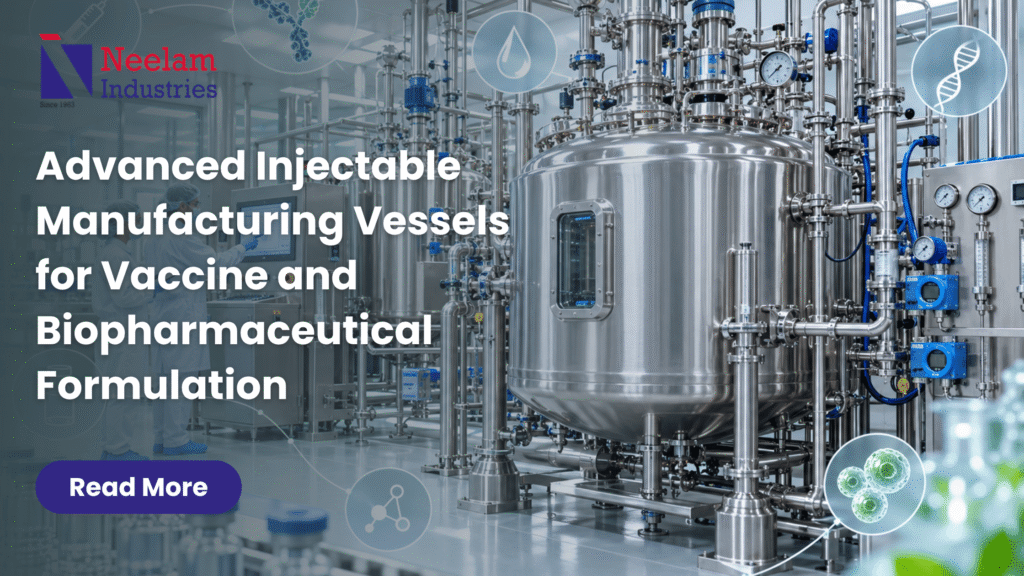
The production of vaccines and biopharmaceuticals is a very controlled process in which each step in the process should ensure protection against contamination and maintain the same quality level.
Sterile manufacturing vessels in India play an essential part in this process since they are specifically designed to handle such substances as sterile liquids, active ingredients, buffers, and other formulations.
India is developing its pharmaceutical and biopharmaceutical industry. That is why it needs manufacturing vessels that can provide good mixing, control the temperature and be easily cleaned.
What Is a Sterile Manufacturing Vessel in India?
Simply put, it is a closed-process tank built to handle injectable formulations without letting contamination in. It can prepare, mix, hold, or transfer liquids under controlled conditions.
In injectable plants, you will see it used for:
- Vaccine formulation
- Biologic solution preparation
- Buffer preparation
- Media preparation
- Sterile liquid holding
- Intermediate storage
Most vessels use SS 316L stainless steel on product-contact surfaces. The final design depends on your product, batch size, process, and how you clean and sterilise.
Why Injectable Manufacturing Vessels Matter
Injectables go straight into the body. Nothing acts as a filter along the way, so the margin for error is tiny.
A good vessel keeps conditions steady from batch to batch and lowers contamination risk. For vaccines and biologics, that repeatability is everything.
Picture a vaccine blend where several components must be mixed at a fixed temperature. The vessel has to stir evenly and hold that temperature the whole time. If it can’t, quality starts to drift.
Key Design Features
A modern pharmaceutical vessel often includes:
- Agitator for even mixing
- Jacket for heating, cooling
- CIP and SIP compatibility
- Load cells for weighing
- Sanitary valves and fittings
- Spray balls for cleaning
- Insulation for stable temperature
Your exact setup should follow your formulation and validated process, not a catalogue.
How Advanced Vessels Support Vaccine Manufacturing
Vaccine work involves sensitive biological materials and tight process limits. So the vessel has to protect both quality and consistency.
Agitation comes first. Too much shear can damage some biological products, while too little mixing leaves uneven concentrations in the batch.
Temperature is the next big factor. A jacketed vessel lets teams manage heat more steadily during formulation and holding.
Then there is the internal finish. Smooth, polished surfaces are easier to clean and leave fewer corners where residue or microbes can hide.
Choosing a Sterile Manufacturing Vessel in India
Indian plants range from small development labs to large commercial sites in Ahmedabad and Hyderabad. So choose based on the actual process, not just volume.
1. Batch Size
Work out your working volume and the headspace you need. The vessel should mix well without being oversized.
2. Material of Construction
Product-contact parts must be pharmaceutical grade. SS 316L is one such preferred material because of its corrosion resistance and surface hygiene.
3. Agitation Requirements
The impeller should be chosen based on the viscosity and sensitivity of the formulation. The shear-sensitive biological would require a less aggressive system than the suspension.
4. Cleaning and Sterilisation
Confirm the vessel supports your CIP and SIP procedures. Drainability matters too, because standing liquid is a hygiene problem.
5. Automation
Systems can include temperature, pressure, level, and weighing sensors with automated controls. Pick what your process truly needs.
6. Documentation
In regulated manufacturing, paperwork matters as much as steel. Ask about material certificates, surface finish reports, weld quality, drawings, and validation documents.
Common Mistakes to Avoid
Choosing only on price or capacity usually causes trouble later. Watch for these:
- Ignoring the formulation
- Overlooking shear limits
- Forgetting drainability
- Discussing CIP/SIP late
- Skipping future expansion plans
- Leaving documentation last
- Using standard designs blindly
A better route is to involve process, production, quality, and engineering teams before the specification is final.
Indian Pharmaceutical Manufacturing Considerations
India has a deep manufacturing base, with major hubs in Ahmedabad, Vadodara, Hyderabad, Mumbai, Pune, and Bengaluru.
Plants making vaccines, injectables, and biologics need equipment that fits both the process and the quality system. Regulatory requirements like those provided by CDSCO and global organizations will influence design, validation, and documentation.
This is why early technical talks help when you are specifying a sterile manufacturing vessel in India. Fixing a design on paper costs far less than fixing it after installation.
FAQ
1. What is a sterile manufacturing vessel in India used for?
The sterile manufacturing vessel in India is used for formulation of pharmaceuticals, manufacture of vaccines, preparation of buffers, and sterile storage.
2. Which material is used for pharmaceutical vessels?
SS 316L stainless steel is the typical material used for product contact surfaces. It is anti-corrosive and maintains the hygienic surfaces.
3. Can the manufacturing vessels be customized?
Yes, customization can be done regarding volume, agitation, jacketing, instrumentation, valves, finish, and automation.
4. Why are CIP and SIP important?
CIP cleans equipment without dismantling it. SIP sterilises it in place. Together they cut manual handling and support consistent hygiene.
5. What do I need to check before purchasing a sterile manufacturing vessel in India?
Review the material, working volume, agitation, temperature control, drainability, CIP/SIP fit, instruments, and documents. Most importantly, check that it suits your formulation.
Conclusion
A sterile manufacturing vessel in India is far more than a steel tank. Its design shapes mixing, temperature control, cleaning, sterilisation, and how consistent your batches turn out.
For vaccines and biologics, define your process first. Then pick equipment around it, not the other way round.
Planning a new line or upgrading an old one? Sterile Pharma Machine can help you compare vessel configurations for your process. Visit Sterilepharmamachine.com and talk to the technical team about your requirements.